Dockworkers Strike at 113 Ports Over Arms and War Deaths
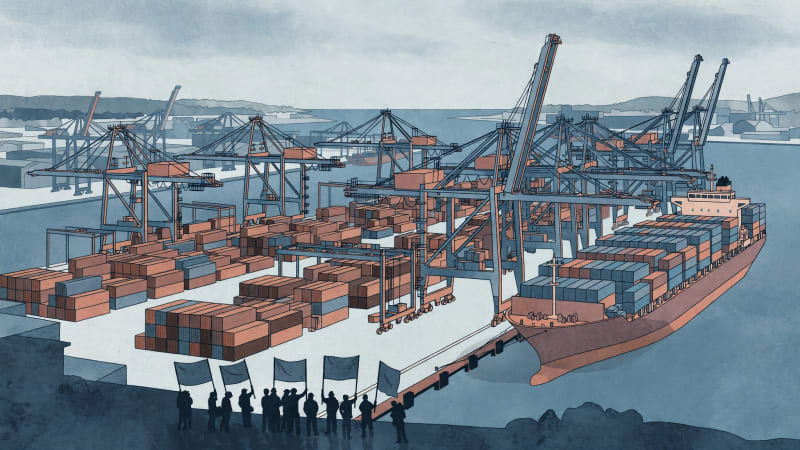
A coordinated stoppage across 113 ports
In Piraeus, Greece's main port, cargo operations were disrupted and ferry services to the Greek islands were suspended on Friday, 30 October 2026, as about 3,000 dockworkers and seafarers joined the walkout.
The walkout covered 113 ports in 22 countries. More than 25 unions backed the strike, originally called in Italy, France, Greece, Spain's Basque Country, Turkey and Morocco. The strike covered major shipping hubs in Piraeus, Valencia, Le Havre, Algeciras and Genoa, as well as Morocco's Tangier Med and India's Nhava Sheva.
What the workers are demanding
The central demand is that commercial ports should not be used to transport weapons, ammunition and military equipment to war zones. The unions argue that dockworkers handle civilian trade, not war logistics. Alongside that demand, strikers called for pay rises, better working conditions and the right to have doctors on board vessels crossing war zones. The unions link the two demands: the same crews who load cargo in peacetime face risk when ships cross waters where fighting is under way.
At Piraeus, Apostolos Kypraios, head of the Greek union of merchant marine engineers, said: "We will not work for their wars, and we will not become food for their cannons." George Gogos, head of the Piraeus port dockworkers' union, said: "We can't even afford to fill the car with fuel to get to the supermarket." Dockworkers said they were also worried about the rising cost of essential goods and energy, stemming from the ongoing conflicts.
The casualty figures behind the protest
The Greek seafarers' union PENEN said seafarers have suffered casualties numbering in the hundreds, including dead and severely injured workers. PENEN said there had been 28 attacks on vessels in the Gulf in the first 21 days of October, a record since the start of the Iran war. It also said there had been 570 confirmed attacks in the Black Sea so far this year, leaving 40 seafarers dead and hundreds wounded. These are PENEN figures, not independently verified official totals; readers should treat the two attack counts as union claims until an official tally is published.
Representatives of India's Water Transport Workers' Federation of India said about 15 Indian seafarers had died as a result of the Iran war, with many more stranded at sea as waterways were blocked. The Indian figure is a union claim, reported as such, and it explains why Nhava Sheva appears in a list otherwise dominated by European and North African ports.
What the disruption figure does and does not prove
A group of dockworkers and other activists called 'No Harbour for Genocide', campaigning to stop military cargo from reaching Israeli ports, said the protest would halt some 52,000 containers and snarl cargo worth $2.8 billion. That impact figure could not be independently verified, and this article repeats it only as the organisers' claim. The concrete disruption on the day was cargo stopped at named ports, ferries suspended from Piraeus, and about 3,000 workers joining the walkout there. The wider figure is an estimate of what could be affected, not a measured total.
Glossary
A civilian port is a commercial port for ordinary cargo and passenger traffic, not a naval base. A seafarer works aboard a merchant vessel. A war zone here means waters where ships face attack risk in an ongoing war, including parts of the Gulf and Black Sea named by the unions. The Istanbul Declaration, published in May 2026 by unions from more than 35 European countries, demanded that ports not be used to transport weapons to war zones.
Who is affected and what to do
Shippers with cargo routed through Piraeus, Valencia, Algeciras, Le Havre, Genoa, Tangier Med or Nhava Sheva on 30 October should expect delays and revised arrival times, and should confirm new schedules with their carriers before promising delivery dates to customers. Time-sensitive cargo faces the highest risk, because a missed sailing cannot always be recovered the next day. Indian exporters and importers using Nhava Sheva should check whether their bookings were rolled to a later sailing and whether port charges or storage terms changed as a result.
What happens next
No follow-up strike date is named by the unions in the material checked for this article. The dated facts are the 30 October stoppage and the May 2026 Istanbul Declaration. Shippers with 30 October cargo should confirm revised arrival times, check rolled bookings at Nhava Sheva and the European hubs, and watch for any union announcement before fixing delivery commitments.
📷 Illustration: AI-generated
Questions people ask
- How big was the strike?
- 113 ports in 22 countries, backed by more than 25 unions, on Friday 30 October 2026.
- Was India involved?
- Yes. Nhava Sheva was among the hubs named, and India's Water Transport Workers' Federation of India said about 15 Indian seafarers had died as a result of the Iran war.
- What were the workers demanding?
- That civilian ports not be used for arms shipments to war zones, plus pay rises, better working conditions and doctors aboard vessels crossing war zones.
- Did the strike really halt 52,000 containers worth $2.8 billion?
- That is the claim of the 'No Harbour for Genocide' group. That impact figure could not be independently verified, so this article reports it only as the organisers' claim.
- Is another strike date announced?
- No follow-up strike date is named by the unions in the material checked for this article.
Sources
- Reuters report, republished by KTWB - Dockworkers strike in Europe and beyond against arms shipments, war deaths (ktwb.com)
- Zark News - Dockworkers strike across 113 ports in 22 countries (zarknews.com)
- Bharat Speaks - Dockworkers across 22 countries launch coordinated strike (bharatspeaks.com)
- Wealth Adviser - Strike at 113 ports protests wars (wealthadviser.co)
Editorial Note: This explainer was researched using verified primary sources and official notifications, then independently fact-checked, reviewed, and finalized under human editorial guidance by the Gagariya desk.
This story is informational only and is not financial advice. Decisions about money belong with a registered adviser — the sources above are a good place to start reading.
Keep reading
business · 31 Oct 2026
US approves $2.1bn sale of 500 Patriot missiles to Ukraine
US approves 500 Patriot missiles for Ukraine, funded by allies — but deliveries could take years.
business · 31 Oct 2026
पेट्रोल निर्यात शुल्क शून्य, डीज़ल ₹11.50/लीटर
पेट्रोल निर्यात शुल्क खत्म, डीज़ल और ATF महंगे हुए निर्यात पर। नई दरें, हिसाब और आगे की समीक्षा।
business · 31 Oct 2026
Sensex 308 अंक चढ़ा, Nifty 23,053 पर बंद
अक्टूबर के आखिरी trading दिन Sensex और Nifty दोनों हरे निशान में बंद हुए, लेकिन broader market कमजोर रहा। अगला session सोमवार 2 नवंबर को होगा।
The day’s verified stories, one email, 7 am IST. No noise.