Why Is There Such a Huge Gap Between Government Schools in India?
India is living in 2026. It is the world's most populated country, a global technology hub and one of the fastest-growing economies. From space exploration to digital payments, India has repeatedly shown that it can build systems admired across the world. Yet, behind these achievements lies a question that affects millions of families every single day—why is the quality of education so different within India's own government school system?
For most children living in rural India, education begins in government schools or small private schools. In urban areas, students generally have more options. They can study in private CBSE schools, state board schools or Kendriya Vidyalayas. While every school is meant to educate the next generation, the learning experience often differs dramatically depending on where a child is born.
Two Government Schools, Two Different Realities
One of the most surprising aspects of India's education system is that both Kendriya Vidyalayas and state government higher secondary schools are publicly funded institutions. The only difference is that one is administered by the Central Government while the other is managed by State Governments.
Despite serving the same purpose, the gap between them is impossible to ignore.
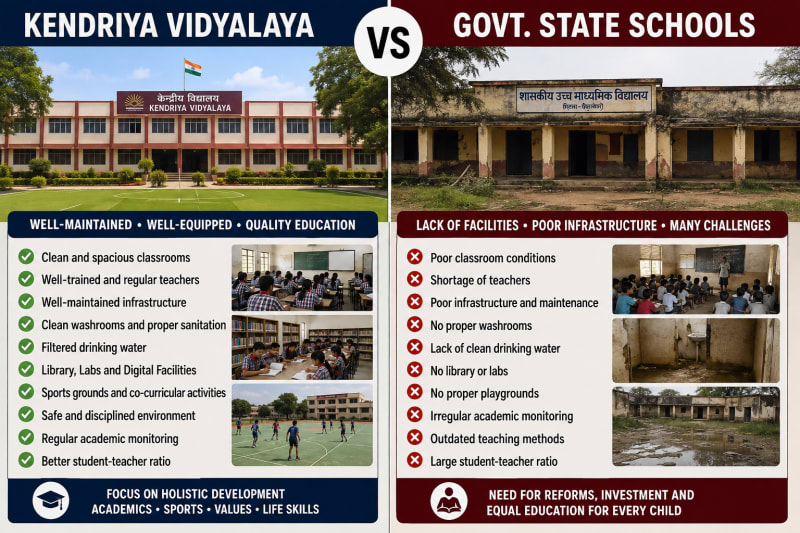
In many Kendriya Vidyalayas, students study in clean classrooms equipped with proper furniture, laboratories, libraries, sports grounds and trained teachers. School campuses are generally well maintained, classrooms are organized and students benefit from structured academic planning.
On the other hand, many state government schools continue to struggle with basic necessities. In several schools, classrooms require repairs, clean drinking water is unavailable, washrooms remain unusable, sanitation is poor and playgrounds are either neglected or completely absent. In some cases, there is also a shortage of teaching staff, making it difficult for students to receive consistent academic support.
Is Infrastructure the Only Problem?
Infrastructure is only one part of the issue.
The quality of teaching also varies significantly. Many teachers work under difficult circumstances and with limited resources. However, there are also concerns about insufficient teacher training, outdated teaching practices and limited exposure to modern educational methods.
While education across the world is becoming increasingly interactive and technology-driven, several government schools still rely heavily on traditional classroom methods. Students often memorize information instead of understanding concepts or developing practical skills.
This creates a learning gap that becomes more visible as students move towards higher education or competitive examinations.
If One Model Works, Why Isn't It Expanded?
Perhaps the biggest question is not whether India can build excellent government schools—it already has.
Kendriya Vidyalayas have consistently demonstrated that quality public education can be delivered through government institutions. Their structured administration, standardized curriculum, teacher recruitment processes and infrastructure provide a model that many parents trust.
This naturally raises an important question.
If India already has a successful public school system, why can't similar standards be implemented across state government schools? Why should a child's education depend on whether they study in a Kendriya Vidyalaya or a state-run institution?
The issue is not about creating an entirely new system. It is about expanding practices that have already proven effective.
The Examination System Raises Similar Questions
The education system is not the only area where differences become visible.
Competitive examinations frequently face allegations of question paper leaks, particularly in some state-level recruitment and entrance examinations. These incidents affect lakhs of students who spend months or even years preparing for a single opportunity.
At the same time, examinations conducted by organizations such as the Union Public Service Commission (UPSC) are generally regarded as having much stronger security and administrative processes.
This leads to another important question.
If secure examination systems already exist within the country, why can't similar processes, technology and accountability mechanisms be adopted more widely for other public examinations?
What Needs to Change?
Improving government education does not necessarily require reinventing the system. It requires consistent implementation, accountability and long-term investment.
- Upgrade school infrastructure, including classrooms, drinking water, sanitation and playgrounds.
- Improve teacher recruitment, regular training and professional development.
- Introduce modern teaching methods supported by digital learning tools.
- Ensure equal access to quality educational resources across rural and urban areas.
- Strengthen examination security using proven administrative systems and technology.
- Regularly evaluate learning outcomes instead of focusing only on examination results.
Education Should Not Depend on a Child's Address
Every child deserves access to quality education, regardless of whether they live in a metropolitan city, a small town or a remote village. Public education should reduce inequality rather than reinforce it.
India has already shown that it can create institutions that compete with the best in the world. The challenge now is to ensure that those standards are not limited to a small section of students.
A stronger public education system would not only improve literacy but also create a more skilled workforce, reduce inequality and strengthen India's long-term economic growth.
What Should India Focus on Next?
The future of India's education system depends on narrowing the gap between different types of public schools. Successful models such as Kendriya Vidyalayas demonstrate that quality government education is achievable. The next step is ensuring that similar opportunities, infrastructure and teaching standards become available to every government school student, irrespective of the state they belong to.
Questions people ask
- Why is there a difference between Kendriya Vidyalayas and state government schools?
- The difference is often attributed to variations in administration, funding, infrastructure, teacher recruitment, training and implementation of educational policies between the Central Government and State Governments.
- Are all government schools in India of poor quality?
- No. Many government schools perform exceptionally well. However, the quality of infrastructure, teaching and resources varies significantly across different states and regions.
- Why are Kendriya Vidyalayas considered better by many parents?
- Kendriya Vidyalayas are widely recognized for their standardized curriculum, trained teachers, better infrastructure, disciplined environment and consistent academic administration.
- Can state government schools improve using the Kendriya Vidyalaya model?
- Many education experts believe that adopting proven administrative practices, strengthening teacher training, improving infrastructure and ensuring accountability could help narrow the quality gap.
- Why is examination security also part of the education debate?
- Repeated allegations of question paper leaks in some examinations have raised concerns about fairness. Strengthening examination systems is viewed as an important step towards improving trust in public education.
Editorial Note: This explainer was researched using verified primary sources and official notifications, then independently fact-checked, reviewed, and finalized under human editorial guidance by the Gagariya desk.
Keep reading

india · 26 Oct 2026
अपर सुबनसिरी में बंद, डापोरिजो में सड़क जाम और वाहनों में आग
26 अक्टूबर को अपर सुबनसिरी में SUHEP के खिलाफ 12 घंटे का बंद; डापोरिजो में सड़क जाम और वाहनों में आग की खबरें। यह सियांग विरोध की अपडेट नहीं है।
india · 26 Oct 2026
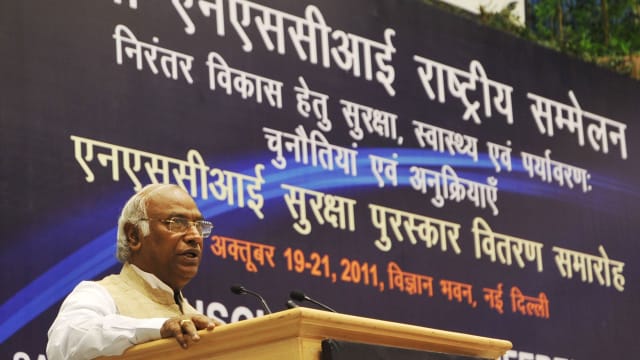
खरगे से माफी की मांग, BJP का देशभर में विरोध
पटना की टिप्पणी पर भाजपा का देशभर में विरोध, बिना शर्त माफी की मांग; कांग्रेस ने बचाव किया।
india · 26 Oct 2026
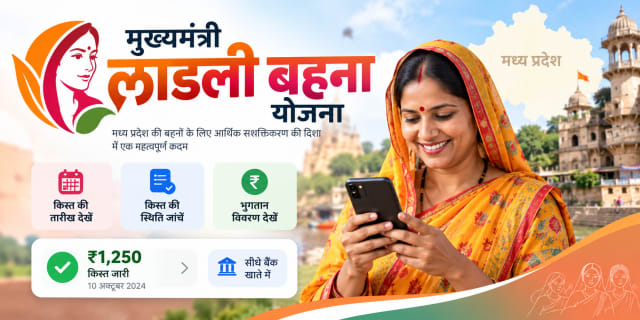
Ladli Behna Yojana Installment: Check Status and Dates
Find out how to check your Ladli Behna Yojana installment status, eligibility criteria, and payment dates for beneficiaries in Madhya Pradesh.
The day’s verified stories, one email, 7 am IST. No noise.