How Sandipani Schools Are Changing Education in Madhya Pradesh
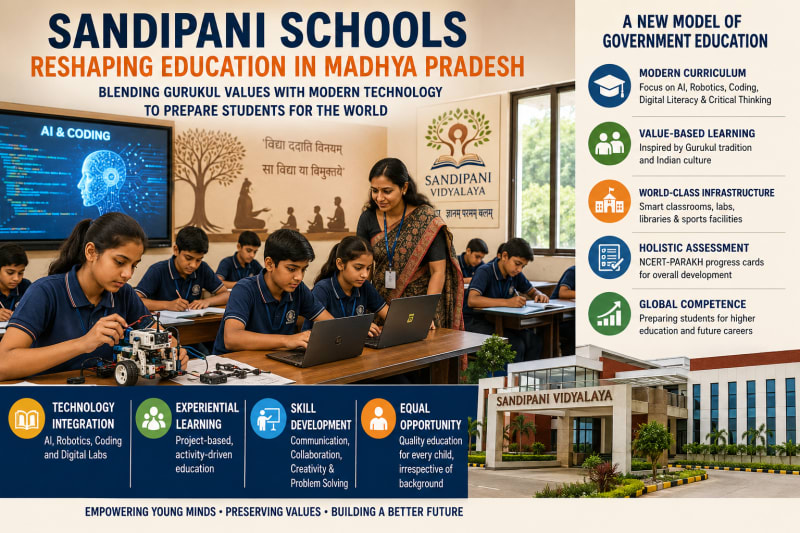
A classroom where students learn coding in the morning, robotics in the afternoon and traditional Indian values alongside science may sound like the blueprint of a premium private school. Madhya Pradesh wants that vision to become a reality in its government education system.
Over the past few years, the state government has introduced Sandipani Schools, a new education model that combines modern technology with the ancient Guru-Shishya philosophy. Named after Maharishi Sandipani—the revered guru of Lord Krishna—the initiative aims to transform government schooling into an ecosystem where academic excellence, character development and future-ready skills develop together. :contentReference[oaicite:1]{index=1}
Why were Sandipani Schools introduced?
For decades, government schools across India have struggled with infrastructure gaps, uneven learning outcomes and declining enrolment as families increasingly turned to private schools.
Madhya Pradesh's answer has been to create a network of high-quality model institutions rather than simply upgrading existing classrooms. Sandipani Schools are intended to provide students with modern facilities, residential education in many cases, digital learning resources and a curriculum that aligns with the National Education Policy (NEP) 2020 while also emphasizing ethics and cultural values. :contentReference[oaicite:2]{index=2}
A blend of Gurukul values and modern technology
Perhaps the most distinctive aspect of the initiative is its attempt to merge traditional education with emerging technologies.
According to the state government's description of the programme, Sandipani Schools integrate value-based education with subjects such as artificial intelligence, robotics, coding and digital technology. The idea is not to replace India's educational traditions but to combine them with skills required in the global economy. :contentReference[oaicite:3]{index=3}
This approach reflects a broader shift in education. Employers increasingly seek problem-solving, creativity and digital literacy alongside academic knowledge. Schools therefore need to prepare students for careers that may not even exist today.
Preparing students for global competition
Education is no longer measured only by board examination marks.
Students now compete for international universities, global scholarships, technology careers and innovation-driven industries. Skills such as computational thinking, communication, collaboration and critical reasoning have become equally important.
Sandipani Schools attempt to address this shift by exposing students to digital technologies and practical learning environments at an early stage. The government's stated objective is to help students from government schools compete confidently with peers from leading private institutions. :contentReference[oaicite:4]{index=4}
Infrastructure that goes beyond classrooms
The state's investment extends beyond textbooks.
Recently inaugurated campuses include modern academic buildings, laboratories and supporting infrastructure. One newly opened Sandipani School in Berasia alone represents an investment of more than ₹50 crore, alongside planned road improvements to improve accessibility. :contentReference[oaicite:5]{index=5}
The broader vision is to create campuses that provide students with a learning environment comparable to high-quality educational institutions rather than conventional government schools.
Education is becoming more holistic
Another major change involves how students are assessed.
Madhya Pradesh has begun introducing NCERT-PARAKH Holistic Progress Cards in selected schools, including Sandipani Schools. Instead of evaluating students only through examination marks, the new assessment framework records participation, behaviour, competencies, interests and overall development throughout the academic year. :contentReference[oaicite:6]{index=6}
This represents a significant shift from rote learning toward continuous, comprehensive evaluation.
Expanding opportunities for disadvantaged students
The initiative is also designed to improve access to quality education.
Government announcements describe Sandipani Vidyalayas as institutions intended to serve talented students, including those from economically weaker backgrounds. The expansion of these schools has been linked with free competitive examination coaching and broader educational support so that financial limitations do not become barriers to opportunity. :contentReference[oaicite:7]{index=7}
If implemented effectively, this could help reduce the educational gap between urban private schools and government institutions.
Challenges remain
Despite the ambitious vision, implementation has not been without criticism.
Recent reports indicate that while several Sandipani campuses have been announced, only a limited number were fully operational at certain stages, resulting in some students being temporarily accommodated in other government schools while construction continued. :contentReference[oaicite:8]{index=8}
Separate reports have also highlighted operational issues such as transportation challenges faced by some students attending Government Sandipani Schools. :contentReference[oaicite:9]{index=9}
These examples suggest that infrastructure alone cannot transform education. Transport, staffing, maintenance and timely project completion remain equally important.
What makes this reform different?
| Area | Traditional Model | Sandipani School Model |
|---|---|---|
| Learning | Textbook-focused | Technology-enabled and experiential |
| Skills | Exam preparation | AI, robotics, coding and digital literacy |
| Assessment | Marks-based | Holistic progress evaluation |
| Values | Academic emphasis | Academic excellence with value-based education |
| Infrastructure | Standard government schools | Modern campuses with upgraded facilities |
Can Sandipani Schools compete with private schools?
That remains the biggest question.
Private schools have spent decades building reputations through infrastructure, extracurricular activities and academic performance. Government schools entering that space must consistently deliver quality teaching, modern facilities and measurable learning outcomes.
If Sandipani Schools succeed in maintaining high teaching standards, integrating technology effectively and providing equal access for students from diverse backgrounds, they could significantly change public perceptions of government education in Madhya Pradesh.
What comes next?
The state government continues expanding Sandipani Schools while aligning them with NEP 2020 reforms, technology-enabled learning and holistic assessment models. :contentReference[oaicite:10]{index=10}
The real measure of success, however, will not be the number of campuses inaugurated. It will be whether students graduate with the confidence, knowledge and practical skills needed to compete in universities, workplaces and innovation-driven economies across the world.
Questions people ask
- What are Sandipani Schools in Madhya Pradesh?
- Sandipani Schools are a flagship initiative of the Madhya Pradesh government that combines value-based education with modern technology, digital learning and upgraded infrastructure to improve the quality of government schooling. :contentReference[oaicite:11]{index=11}
- How are Sandipani Schools different from traditional government schools?
- The schools emphasize technology-enabled learning, AI, robotics, coding, holistic assessment and improved infrastructure while retaining value-based education inspired by the Guru-Shishya tradition. :contentReference[oaicite:12]{index=12}
- Do Sandipani Schools prepare students for global careers?
- The stated objective is to equip students with modern skills such as digital literacy, artificial intelligence and robotics while strengthening foundational education and character development, helping them compete in higher education and future careers. :contentReference[oaicite:13]{index=13}
- What challenges do Sandipani Schools still face?
- Reports have highlighted delays in completing some campuses and operational issues such as student transportation at certain locations, indicating that implementation remains an ongoing challenge despite the programme's ambitious goals. :contentReference[oaicite:14]{index=14}
- How does the new assessment system work?
- Selected Sandipani Schools are adopting NCERT-PARAKH Holistic Progress Cards, which assess academic performance alongside behaviour, competencies, participation and overall student development rather than relying only on examination marks. :contentReference[oaicite:15]{index=15}
Sources
- Guru Purnima today: How Madhya Pradesh showcases Sandipani schools as new education model (livemint.com)
- MP expands Sandipani and PM SHRI schools (nationpress.com)
- 52-page holistic progress card to debut in MP schools (timesofindia.indiatimes.com)
- Rs 50.74-crore Sandipani school opens in Berasia (timesofindia.indiatimes.com)
Editorial Note: This explainer was researched using verified primary sources and official notifications, then independently fact-checked, reviewed, and finalized under human editorial guidance by the Gagariya desk.
Keep reading

india · 26 Oct 2026
अपर सुबनसिरी में बंद, डापोरिजो में सड़क जाम और वाहनों में आग
26 अक्टूबर को अपर सुबनसिरी में SUHEP के खिलाफ 12 घंटे का बंद; डापोरिजो में सड़क जाम और वाहनों में आग की खबरें। यह सियांग विरोध की अपडेट नहीं है।
india · 26 Oct 2026
खरगे से माफी की मांग, BJP का देशभर में विरोध
पटना की टिप्पणी पर भाजपा का देशभर में विरोध, बिना शर्त माफी की मांग; कांग्रेस ने बचाव किया।

india · 26 Oct 2026
Ladli Behna Yojana Installment: Check Status and Dates
Find out how to check your Ladli Behna Yojana installment status, eligibility criteria, and payment dates for beneficiaries in Madhya Pradesh.
The day’s verified stories, one email, 7 am IST. No noise.