Economics Nobel 2026: Hall, Woodford win for stabilisation
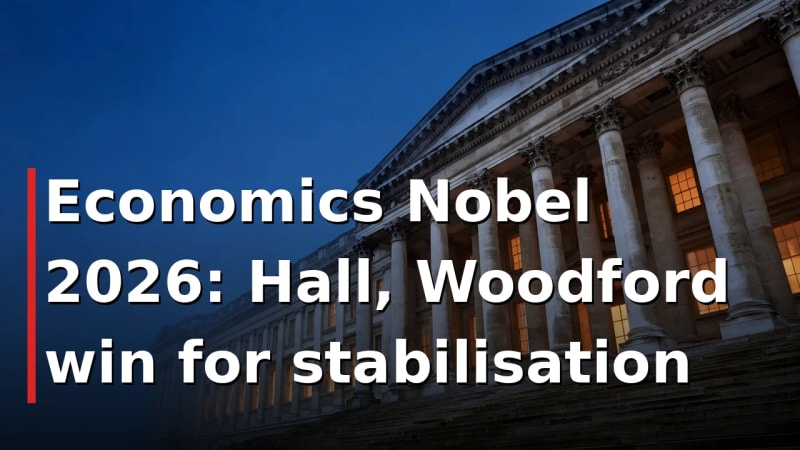
The announcement
The Royal Swedish Academy of Sciences announced on Monday that the 2026 Nobel economics prize has gone to two Americans: Robert E. Hall of Stanford University and Michael Woodford of Columbia University. The award, worth 12 million Swedish crowns ($1.2 million) to be split equally between them, honours their work "for microeconomic foundations of macroeconomic stabilisation".
It is the final Nobel of the year. Medicine, physics, chemistry, literature and peace were all announced last week, so the economics prize brings the 2026 season to a close. The two laureates each receive 6 million Swedish kronor (about $598,000), along with the usual diploma and gold medal.
"The laureates have helped us smooth out the economy's peaks and troughs," the Academy said. As prize committee chair John Hassler put it, their work "has provided us with a stable theoretical foundation for the models that are now used by central banks and governments around the world."
Hall and Woodford spent decades on a question that sounds simple and turns out to be anything but: when governments and central banks try to steady an economy, why do their plans sometimes fail?
What the citation actually means
Start with how economics used to work. Traditional models treated the economy like a machine with levers. They drew statistical lines between big variables (inflation, production, consumption) and assumed those lines held steady. If inflation rose, raise rates; if growth sagged, cut them. The relationships in the spreadsheet were the policy.
Hall and Woodford built from the ground up instead. Their models start with millions of individual households and businesses making decisions; those decisions, crucially, are forward-looking. People do not just react to today's interest rate. They react to what they expect rates, jobs and prices to do next year.
That changes everything for policymakers. If households are looking ahead, then what a central bank says about its future plans can move the economy as surely as what it does today. Clear communication about fiscal and monetary policy can, as the Academy put it, "move the economy in the right direction". This is the insight that won the prize: stabilisation policy rebuilt on microeconomic foundations rather than on statistical averages.
The two laureates
Hall, born in Palo Alto, California, in 1943, is 83, according to AFP, and a professor at Stanford University. In 1978 he published a seminal paper on consumption that the Academy described as "something of a eureka moment". His central idea: what a household spends today reflects what it expects its lifetime wealth to be. People adjust spending only when new, unexpected information changes that expectation, which means future changes in consumption cannot be predicted from past data. Economists call this the random walk hypothesis.
He also showed that labour markets have search frictions (the messy, slow process of matching workers to jobs), which helps explain why unemployment lingers long after a recovery begins.
Woodford, born in Chicopee, Massachusetts, in 1955, is a professor at Columbia University. In 2003 he published a book presenting what the Academy called a "New Keynesian macro model built upon microfoundations". He paired Hall's discovery about forward-looking households with the old idea of the neutral interest rate: the rate at which an economy runs at its potential with stable inflation, a concept Swedish economist Knut Wicksell developed. Since firms face costs when changing prices, those prices are "sticky". That stickiness makes expectations, and how banks manage them, decisive.
Woodford was preparing an exam for his students when the call came. "It's a staggering piece of news," he told the Nobel Foundation, adding with a laugh: "They're probably hoping I'll cancel the exam." On the phone to the prize committee from New York, he called it "a tremendous honor" and "a surprise".
How their work changed central banking
The story runs through a century of economic thought. Stabilisation policy (the idea that governments and central banks should smooth out booms and busts) grew out of John Maynard Keynes's work during the Great Depression of 1929 to 1939. Keynes argued that demand from households and businesses does not automatically match what the economy can produce, so when demand collapses, public spending or rate cuts can cushion the fall. That challenged the old belief that free markets correct themselves.
For a while the recipe worked. Then came the oil shocks of the 1970s. Economies were hit by stagnant growth, high unemployment and persistent inflation all at once, stagflation, and the Keynesian models had no answer. In 1976, economist Robert Lucas, who would win the Nobel himself in 1995, argued the deepest problem was the models' assumption that relationships between variables were stable and proportionate. People are not a fixed system: when policy is built on past behaviour, people change their behaviour, and the policy stops working.
Hall and Woodford's answer was to model people as they actually are: forward-looking, reacting to news, forming expectations. And that produced a new policy tool: forward guidance. If a central bank clearly signals it will keep rates low for the next two years, long-term borrowing costs can fall immediately, stimulating investment today, without the bank cutting rates any further. Transparency itself becomes a lever.
The 2008 financial crisis was the proving ground. Interest rates had already been cut to zero in many countries, so traditional tools were spent. Central banks began making far more explicit statements about where they believed rates were headed, a practice that continues to this day. Woodford is honest about what it achieved: "I think it did contribute to better stabilization. It didn't magically solve the problem, but I think it was an important contribution."
An awkward footnote at the Fed
The timing is striking. The prize honours work on monetary policy and central-bank communication at the very moment America's central bank is rewriting its own communication playbook. The Federal Reserve is under what AFP describes as unprecedented pressure from President Donald Trump to cut interest rates, even as the bank has, AFP reports, recently hiked rates to combat inflation. Fed Chair Kevin Warsh, who assumed office in May according to AFP, has revamped the bank's communication strategy: reducing transparency around policy discussions and stepping away from roadmaps of future action, on the argument that markets should react to data rather than parse central-bank statements.
Woodford, asked about the shift in an AFP interview, kept his distance: "I think it's very appropriate to periodically reassess these things." He also noted that the forward-guidance framework developed after 2008 "was developed in a situation that was certainly very different from where we find ourselves right now."
A prize with an asterisk
Purists will note, as the New Indian Express does, that the economics prize is technically not a Nobel Prize at all. It was established by Sweden's central bank in 1968, first awarded in 1969, and is formally the Sveriges Riksbank Prize in Economic Sciences in Memory of Alfred Nobel. Alfred Nobel's 1895 will created the original five prizes for the dynamite inventor's fortune; economics was added seven decades later. It is still presented with the others every year on December 10, the anniversary of Nobel's death in 1896.
With Hall and Woodford, the total number of economics laureates stands at 101 individuals, only three of whom have been women. The most recent was Claudia Goldin in 2023, honoured for her work on how gender has affected pay and employment. Last year's prize went to Joel Mokyr, Philippe Aghion and Peter Howitt for their work on "creative destruction" and how new technology and production methods boost growth and living standards. And Clarivate's analysis had flagged researchers working on monetary policy as possible recipients this year, according to Reuters. This time the prediction landed.
Old models vs the new framework
| Old Keynesian models | The new Keynesian framework | |
|---|---|---|
| Built on | Statistical links between macro variables: inflation, production, consumption | Decisions of individual households and businesses, modelled from the micro level up |
| View of people | Past behaviour predicts future behaviour | People are forward-looking; they react to policy announcements |
| Main tools | Cut taxes and rates to boost growth; raise rates to fight inflation | Plus forward guidance: shaping expectations through clear communication |
| Weak spot | Oil shocks of the 1970s; stagflation broke the models | Supply shocks still test it; the 2008 framework was built for a different world |
What to watch
The medals are presented in Stockholm on December 10. Beyond the ceremony, the question that made Hall and Woodford famous is still live: can clear communication from central banks keep economies stable when the shocks themselves (energy crises, wars, sudden shifts in how households spend) refuse to be predictable? The Academy's answer, with this prize, is that we are "better equipped to deal with shocks" than before. The next few years will be the test of whether that equipment is enough.
Questions people ask
- What did Hall and Woodford win the economics Nobel for?
- They won for 'microeconomic foundations of macroeconomic stabilisation'. Instead of modelling the economy through statistical links between big variables like inflation and production, they built models from how real households and businesses make forward-looking decisions. Central banks now use these models to time fiscal and monetary policy.
- What is 'forward guidance' and why does it matter?
- Forward guidance is when a central bank publicly commits to a future path for interest rates. Because households and businesses plan ahead, clear statements about future rates can lower borrowing costs and stimulate investment today, without the bank cutting rates further. After the 2008 crisis, with rates near zero, this communication became a core policy tool.
- Is the economics Nobel a real Nobel Prize?
- Technically, no. Alfred Nobel's 1895 will created five prizes; the economics award was established by Sweden's central bank in 1968 and first given in 1969. Its formal name is the Sveriges Riksbank Prize in Economic Sciences in Memory of Alfred Nobel. Still, it is announced and presented alongside the other Nobels every December 10.
- Who won the economics Nobel last year?
- The 2025 prize went to Joel Mokyr, Philippe Aghion and Peter Howitt for their work on 'creative destruction' — how new technology and production methods boost growth and living standards even as they displace older firms. Including Hall and Woodford, 101 individuals have now received the economics prize.
- Why does this research matter for ordinary people?
- Central banks set the interest rates that shape mortgages, business loans and prices. Hall and Woodford's work improved how banks anticipate the effects of rate changes and communicate their plans, making downturns shallower and inflationary episodes less prolonged, according to the Nobel Committee. Stable prices and jobs are the direct payoff.
Sources
- Reuters: Americans Hall and Woodford win 2026 Nobel economics prize (reuters.com)
- CNN: Two Americans win Nobel prize for models to tackle economic downturns (cnn.com)
- The Hindu: Nobel Prize in economics 2026: Robert E. Hall, Michael Woodford win the award (thehindu.com)
- Indian Express Explained: How Hall, Woodford reshaped modern economic policy (indianexpress.com)
- Hindustan Times: Michael Woodford and Robert E Hall win 2026 Sveriges Riksbank Prize (hindustantimes.com)
- New Indian Express: Robert Hall and Michael Woodford win Nobel economics prize (newindianexpress.com)
- Phys.org (AFP): Americans Hall and Woodford win economics Nobel for stabilization models (phys.org)
Editorial Note: This explainer was researched using verified primary sources and official notifications, then independently fact-checked, reviewed, and finalized under human editorial guidance by the Gagariya desk.
This story is informational only and is not financial advice. Decisions about money belong with a registered adviser — the sources above are a good place to start reading.
Keep reading
business · 26 Oct 2026
रद्द टिकट पर GST रिफंड: GSTAT का फैसला क्या कहता है
GSTAT ने रद्द टिकटों पर GST रिफंड की अनुमति दी है, बशर्ते एयरलाइन ने यात्रियों को पूरा किराया और टैक्स लौटाया हो और इसका सबूत हो।
business · 25 Oct 2026
अक्टूबर में विदेशी निवेशकों ने ₹48,056 करोड़ निकाले
अक्टूबर में FPI निकासी ₹48,056 करोड़; 2026 का कुल आँकड़ा ₹3.08 लाख करोड़ — पूरे 2025 का लगभग दोगुना। छोटे शेयरों पर सबसे ज़्यादा मार।
business · 25 Oct 2026
भुवनेश्वर में RBI का ₹169 करोड़ डेटा सेंटर शुरू
RBI का नया डेटा सेंटर भुवनेश्वर में शुरू — ₹169 करोड़, 18.55 एकड़, Tier IV प्रमाणन, RTGS-NEFT की बैकअप व्यवस्था।
The day’s verified stories, one email, 7 am IST. No noise.