Nobel Medicine 2026: Trio Wins for Brain's Light Switch
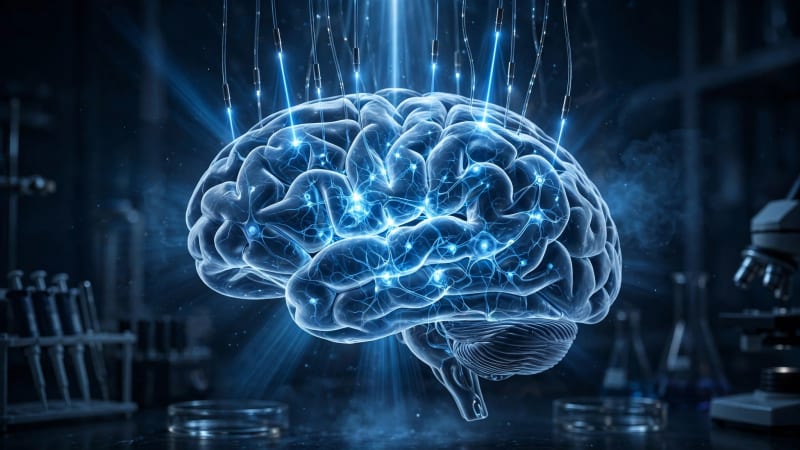
The call from Stockholm reached Karl Deisseroth in the middle of the night, and he had just about given up on sleep anyway. The Stanford psychiatrist is a self-described night owl. He had been up late in his Northern California home, working on papers and emailing his students, and had only just gone to lie down when the Nobel Assembly rang. "No real sleep was achieved," he told the Associated Press, an hour after his life had quietly changed.
His first thought after the prize was not about Stockholm at all. His children were still sound asleep. "That’s my one obligation I have in the next few hours, to make sure I make their sandwiches," he said. The newest Nobel laureate in medicine had packed lunches to make.
Deisseroth, 54, won the 2026 Nobel Prize in Physiology or Medicine alongside two German scientists, Peter Hegemann, 71, and Georg Nagel, 73. The Nobel Assembly of Sweden’s Karolinska Institutet honoured the trio for "discoveries concerning light-gated ion channels and optogenetics". The three will share a prize sum of 12 million Swedish kronor, about $1.2 million.
The medicine prize traditionally opens Nobel week. Physics follows on Tuesday, chemistry on Wednesday, literature on Thursday, the peace prize on Friday, and the economics prize on 12 October.
A light switch for the living brain
Optogenetics is, at its core, startlingly simple to describe and almost miraculous in what it allows. It "makes it possible to switch on, or off, the activity of individual nerve cells in a living brain," as the Nobel Assembly put it.
The technique starts with a protein borrowed from algae that reacts to light. Scientists introduce the gene for that protein into specific neurons. Shine a pulse of blue light on those neurons and they fire; variants of the technique can silence them. For the first time, neuroscientists could flip individual brain cells like switches and watch what changed, testing cause and effect in the brain’s wiring rather than merely observing it.
The Assembly said the payoff has been enormous. "Using optogenetics, researchers have been able to reveal neural circuits governing specific memories, feelings and behaviors relevant for neurological and psychiatric disorders," it said in its statement. And the method has spread fast: "This method is now being used in laboratories around the world to reveal the brain’s mysteries."
It began with a pond alga’s sense of direction
The story behind this year’s prize runs for nearly three decades, and it starts with a question nobody else was asking. In the 1990s, Peter Hegemann, then working at the Max Planck Institute for Biochemistry in Germany, became curious about a single-celled alga called Chlamydomonas. The organism has no eyes and no nervous system, yet it swims toward light. Hegemann wondered how.
He found the answer in a light-sensitive protein. That discovery alone was significant, but it took a partnership to turn it into something more. In the early 2000s, Hegemann teamed up with Georg Nagel, then at the Max Planck Institute for Biophysics in Frankfurt. Together they showed that the protein works like a switch: exposed to light, it opens a channel in the cell surface, letting charged ions flow through and triggering an electrical signal. They named the protein channelrhodopsin.
"They had just discovered the switch neuroscientists had long dreamed of," Abdel El Manira, a neuroscientist and member of the Nobel Committee, said during the announcement.
The final leap belonged to Deisseroth. Working at Stanford, he genetically engineered nerve cells from rats so that they produced channelrhodopsin themselves, then activated those cells by shining light on them. That work was published in 2005. Two years later, he demonstrated the technique inside the brains of living mice. A research tool had become a research era.
The committee was emphatic about what that era made possible. Anna Wedell, a member of the Nobel committee, called optogenetics a "light-sensitive switch" that lets scientists "map which cells are responsible for which function" in the brain. Per Svenningsson, the chair of the Nobel Committee for Physiology or Medicine, put it this way: "Optogenetics provides opportunities for mapping the brain in a way that we could once only dream of."
The three laureates
| Laureate | Based at | The work |
|---|---|---|
| Karl Deisseroth, 54 (American) | Stanford University, California | Engineered rat nerve cells to produce channelrhodopsin (2005), then demonstrated the technique in the brains of living mice (2007), turning a protein into optogenetics. |
| Peter Hegemann, 71 (German) | Humboldt University, Berlin | In the 1990s, discovered the light-sensitive protein while studying how the alga Chlamydomonas senses and swims toward light. |
| Georg Nagel, 73 (German) | University of Würzburg | With Hegemann, showed the protein opens an ion channel on exposure to light, the switch at the heart of the method. |
Thomas Perlmann, the secretary-general of the Nobel Assembly, said he managed to reach all three winners by phone before the public announcement. All were, he said, "very surprised." Deisseroth, he added, "was definitely asleep, but he woke up." All three told him the same thing: it was wonderful to share the prize with the other two.
What this could mean for patients
Optogenetics began as a tool for basic research, but it is edging toward the clinic.
In clinical trials, researchers are attempting to restore vision in people blinded by retinitis pigmentosa, a degenerative eye condition, by inserting a light-sensitive protein into the retina. The idea is the same one that won the prize: give cells a light-sensitive switch, then use light to make them work.
Researchers also hope the technique could improve cochlear implants. Optogenetics allows far more precise stimulation of the auditory nerve than the electrical pulses current implants use, which could mean sharper hearing for recipients.
The field has also reshaped how scientists study how specific cell types drive behaviours such as learning, fear, addiction and movement. That understanding may one day open treatments for neurological and sensory disorders such as Parkinson’s disease and epilepsy, though the Nobel Assembly was careful to frame that as possibility, not promise.
What comes next in Nobel week
The medicine prize is only the first announcement. Here is the rest of the week’s schedule:
- Physics: Tuesday, 6 October, announced by the Royal Swedish Academy of Sciences.
- Chemistry: Wednesday, 7 October, announced by the same academy.
- Literature: Thursday, 8 October, announced by the Swedish Academy.
- Peace: Friday, 9 October, announced by the Norwegian Nobel Committee in Oslo.
- Economic Sciences: Monday, 12 October, announced by the Royal Swedish Academy of Sciences.
The laureates will receive their diploma, gold medal and share of the prize money from King Carl XVI Gustaf at a formal ceremony in Stockholm on 10 December, the anniversary of the 1896 death of the prize’s creator, the Swedish inventor Alfred Nobel. Each year’s announcements are streamed live on the Nobel Prize’s official digital channels, including a YouTube live stream for each prize.
For comparison, last year’s medicine prize went to Americans Mary Brunkow and Fred Ramsdell and Japan’s Shimon Sakaguchi, honoured for work shedding light on how the immune system spares healthy cells, an advance that could open new treatments for diseases such as cancer.
The physics announcement lands on Tuesday. After that, the question hanging over this year’s medicine laureates is how far their switch can travel. The retinitis pigmentosa trials are the furthest advanced, and a light-based treatment that gives blind people sight back would be the most dramatic dividend a neuroscience prize has ever paid. Laboratories around the world, in the committee’s own words, are still busy revealing the brain’s mysteries. Monday’s call to a sleepless scientist in California simply made the debt official.
Questions people ask
- What is optogenetics?
- Optogenetics is a technique that uses light-sensitive proteins to control brain cells. Scientists insert the gene for such a protein into specific neurons, then shine pulses of light to switch those neurons on or off in a living brain, letting researchers test how particular cells shape memories, feelings and behaviour.
- Who won the 2026 Nobel Prize in Medicine?
- The 2026 laureates are Karl Deisseroth, 54, an American based at Stanford University in California; Peter Hegemann, 71, of Humboldt University in Berlin; and Georg Nagel, 73, of the University of Würzburg. Hegemann and Nagel discovered the light-sensitive protein channelrhodopsin, and Deisseroth turned it into a tool for controlling nerve cells.
- How could optogenetics help patients?
- Researchers are already testing the technique in clinical trials to restore vision in people blinded by retinitis pigmentosa, by inserting a light-sensitive protein into the retina. Scientists also hope it could improve cochlear implants with more precise auditory-nerve stimulation, and it may one day aid treatments for Parkinson’s disease and epilepsy.
- When are the other 2026 Nobel prizes announced?
- The physics prize is announced on Tuesday, 6 October, chemistry on Wednesday, literature on Thursday, the peace prize on Friday and the economics prize on Monday, 12 October. The medicine prize traditionally opens the week, and the laureates receive their awards at a formal ceremony in Stockholm on 10 December.
- How much prize money do the winners get?
- The three laureates share 12 million Swedish kronor, roughly $1.2 million. The money is split between them, and each also receives a diploma and a gold medal from King Carl XVI Gustaf at the ceremony in Stockholm on 10 December, the anniversary of Alfred Nobel’s death.
Sources
- Reuters: American Deisseroth and Germans Hegemann and Nagel win 2026 Nobel medicine prize (reuters.com)
- AP via NPR: Nobel medicine prize goes to 3 scientists for research into brain activity (kdlg.org)
- The Hindu BusinessLine: German and US scientists win Nobel medicine prize for work on optogenetics (thehindubusinessline.com)
- CNN: Nobel Prize in medicine awarded to trio for technique that helps decode mysteries of the brain (cnn.com)
- New Scientist: Nobel prize for medicine goes to trio who developed optogenetics (newscientist.com)
- WSJ: Trio Awarded Nobel Prize in Physiology or Medicine for Neuroscience Discoveries (wsj.com)
- Nature: Medicine Nobel awarded for brain ‘switch’ that controls neurons with light (nature.com)
Editorial Note: This explainer was researched using verified primary sources and official notifications, then independently fact-checked, reviewed, and finalized under human editorial guidance by the Gagariya desk.
Keep reading

science · 25 Oct 2026
UK, Europe clocks go back today: India time gap shifts
London is now five and a half hours behind India after UK and EU clocks went back on 25 October 2026. The US follows on 1 November.

science · 25 Oct 2026
Vanuatu quake: 6.9 magnitude, tsunami warning lifted
First measured at 7.2 then revised to 6.9, the Vanuatu quake triggered a tsunami warning that was lifted within hours. Why the numbers differ, and what to watch.

science · 25 Oct 2026
बंगाल की खाड़ी में चक्रवात अरनब की आहट: 28 अक्टूबर को लैंडफॉल
IMD के अनुसार बंगाल की खाड़ी का दबाव 28 अक्टूबर तक अत्यंत प्रचंड चक्रवाती तूफ़ान बनकर आंध्र तट से टकरा सकता है, हवाएँ 140 kmph तक।
The day’s verified stories, one email, 7 am IST. No noise.